Which size pill organizer closes over your capsules: Small to 3XL, counted
The lid that will not shut on the first Sunday a fish-oil capsule joins the schedule is the commonest complaint we hear. What each size actually holds, how to count a dose, and when a second box beats a bigger one.
This page is general information about medication tools, not medical advice. Whether a tablet may be split or crushed, how much of a medicine to give and what to do about a missed dose are questions for the pharmacist who filled the prescription and the doctor who wrote it.
The complaint arrives the same way every time. The box worked for a month. Then a fish-oil capsule joined the schedule, or a calcium tablet the size of a lozenge, and on the next Sunday the lid on Wednesday would not shut. The organizer was not wrong. It was the wrong size, and the size was chosen by looking at the box instead of counting the dose. So count the dose first.
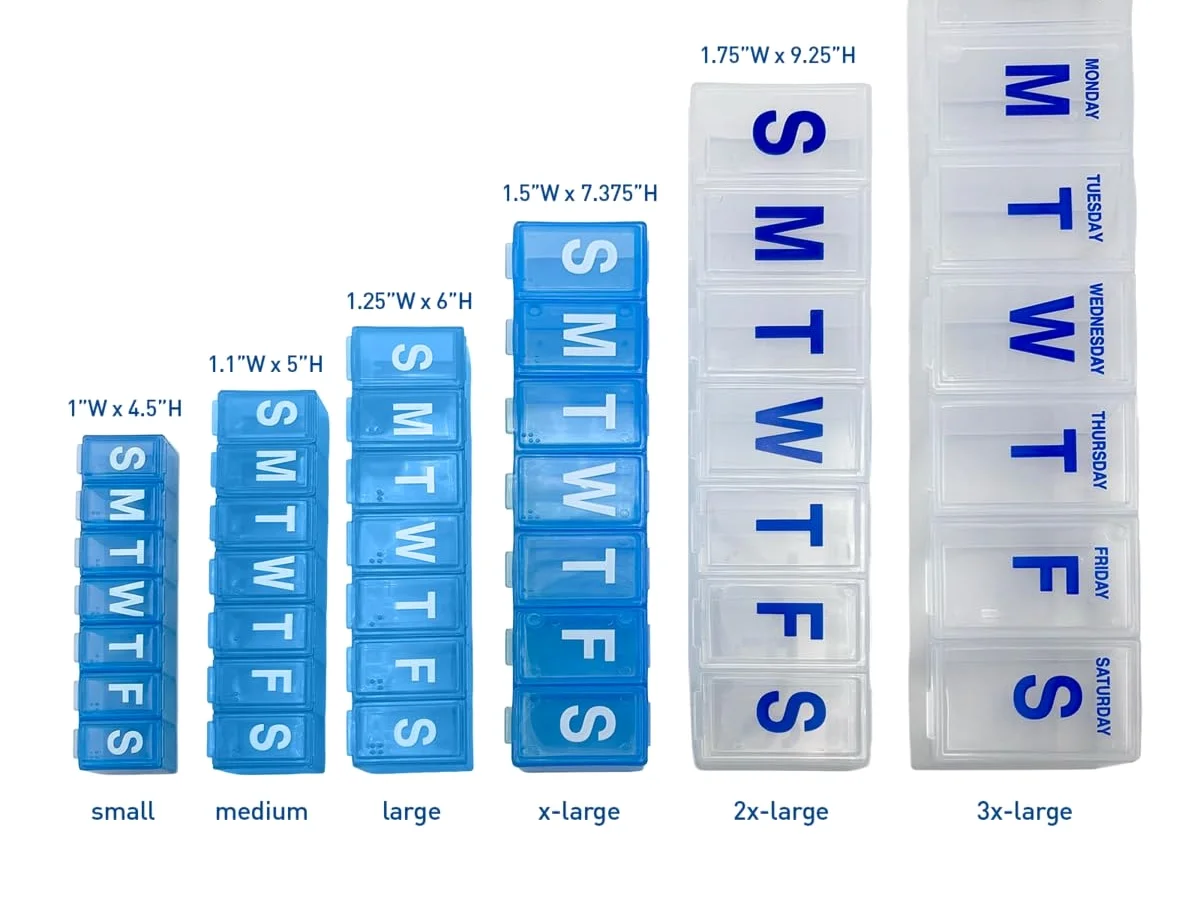
Our sizes run Small, Medium, Large, XL, 2XL and 3XL, and the names describe the compartment, not the tray. A 3XL weekly is long, about eleven inches across seven lids, but what makes it a 3XL is that each of those lids closes over sixty aspirin-sized tablets. A Small weekly fits a shirt pocket because each compartment takes a few. Everything between them is a question of how much goes into one day, so start there.
Count a dose, not a bottle
Put the bottles on the table and count what goes into a single compartment on a single day. Not the week, not the month: one lid. Two tablets at breakfast is two. Two tablets plus a multivitamin is three items, but the vitamin is the size of three tablets, so it counts as four or five. A fish-oil capsule is the size of five or six aspirin. A calcium tablet, a magnesium tablet, a glucosamine tablet: each of those is a large item, and each one is the thing that stops a lid closing.
Then write the number down, because the label on the box speaks in aspirin. When a compartment says it holds up to thirty pills, that is thirty aspirin, which in practice means a lid that closes over a multivitamin, a capsule and four or five ordinary tablets. When it says eleven, that is two or three ordinary tablets and nothing wider than a fingernail.
A useful shortcut: if the dose has a capsule in it, the answer is XL or bigger. Capsules are the item that breaks a Large.
What each size closes over
| Size | One compartment holds, in aspirin | What that means on the table | Who buys it |
|---|---|---|---|
| Small | around eight to eleven | two or three small tablets | one prescription, or a pocket box for a day out |
| Medium | around ten to twelve | three tablets, or two and a small vitamin | the commonest single-prescription box |
| Large | around twenty to thirty | three tablets and a multivitamin | most households; the size the range is bought in |
| XL | around thirty | a capsule, a multivitamin and four tablets | the first Sunday a capsule joins the schedule |
| 2XL | thirty and up | two capsules and a handful of tablets | a schedule with supplements alongside prescriptions |
| 3XL | up to sixty | anything a pharmacist hands out for one day | six or more items a day, or a carer filling for someone else |
The figures are ranges because the same size name sits on trays with different layouts. A Large AM/PM box has two compartments per day, so each is shallower than the single compartment of a Large weekly. A Medtime four-times-a-day tray in Large has four per day, and each of those holds around eleven. If the schedule has more than one dose a day, the compartment count divides the space, and the size has to go up a step to hold the same day.
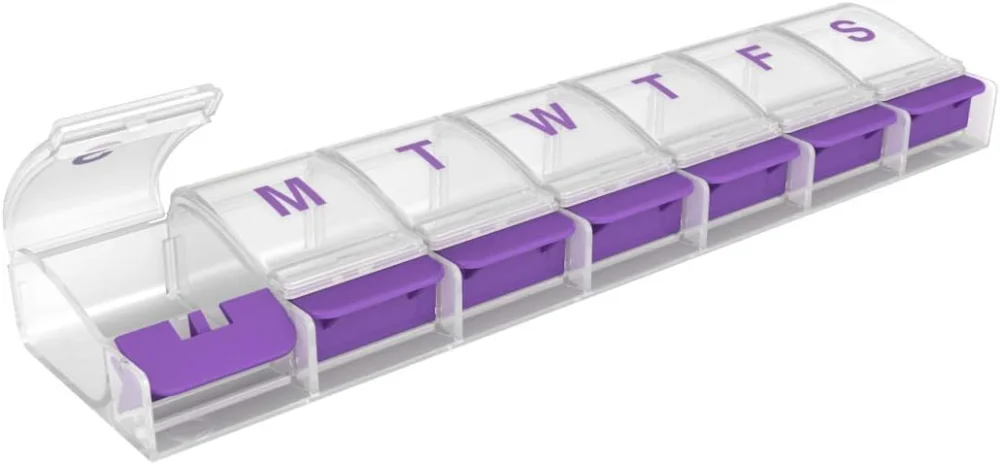
Ezy Dose Weekly 7-Day Pill Organizer, push button, XL
7 days · XL compartments · Push button lids
$9.32
The two boxes that solve the same problem
There are two ways to fit a big day into a tray. One is a bigger compartment: go from Large to XL, or from XL to 3XL, and put everything for the day in one lid. The other is more compartments: keep the size and move to an AM/PM tray, so the morning items sit in one lid and the evening items in another, and neither lid has to close over the whole day.
The second route is the better one whenever the doses happen at different times. A blood-pressure tablet at breakfast and a statin at bedtime do not belong in one compartment, because a compartment that holds both cannot tell you which one was taken. Two lids in two colours can. So before going up a size, ask whether the day is one dose or two. If it is two, an AM/PM box in the same size usually closes where the weekly would not, and it reads better on the counter.
Go up a size when the dose is genuinely one dose and it is simply large. A morning with a multivitamin, a fish-oil capsule, a probiotic and two tablets is one event, and it wants one XL compartment rather than being split across two lids for no reason.
Sunday, and what the depth costs
A deep compartment is easier to fill and harder to empty. Filling is the Sunday job, and a wide-mouthed XL lid takes a fistful of items without any of them bouncing out. Emptying is the every-morning job, and a small tablet at the bottom of a 3XL compartment has to be chased into a corner with a finger, which is exactly what a stiff hand does not want to do at seven in the morning.
The push-button trays answer that with a rounded floor: the tablet rolls to the front when the lid opens. If the schedule needs a 2XL or a 3XL and the hands are not what they were, the push-button version of that size is worth the difference, and it is the one the Arthritis Foundation has certified. A snap-lid 3XL is fine for a carer filling and a steady hand emptying.
There is one more thing depth costs, and that is rattle. Two tablets in a 3XL compartment have room to move, and a box that rattles in a bag announces itself. A compartment matched to the dose is full enough to stay quiet.
Where the box has to live
Length is the last number. A Small weekly is about four and a half inches. A Large is about six. An XL runs a little under nine, a 2XL a little over nine, and a 3XL about eleven, and on the AM/PM trays add the second row to the width. A 3XL does not live in a medicine cabinet; it lives on a counter, which is also where it belongs, since a box you have to open a cupboard to see is a box that gets forgotten.
Measure the shelf or the corner of the counter before choosing between XL and 3XL. It is the difference between a box that sits beside the kettle and one that has to be moved to make toast.
Two boxes instead of one bigger one
Sometimes the answer is not a bigger box. A household with two people on two schedules is two boxes, in two colours, filled on the same Sunday, and the two-packs on the bundle shelf exist for that. A person with a morning of prescriptions and an evening of supplements is sometimes better with a Medium weekly for the prescriptions and a Large weekly for the rest, because the prescriptions are the ones that must not be missed and a box of their own makes a missed one visible.
A carer filling for a parent has a different question, and the monthly cases answer it: thirty-one compartments filled once, numbered by date, so nobody needs a calendar beside the box. Those are covered in the guide on filling a monthly organizer for someone else.
A quick way to decide
Count one day's items and give each capsule or large tablet the weight of five aspirin. Under ten: Small or Medium. Ten to twenty: Large. A capsule in the count: XL. Two capsules or six items: 2XL or 3XL. Then ask whether the day is one dose or two, and if it is two, take the AM/PM tray in that size instead of the next size up. Then measure the counter.
If the lid still will not close on the first Sunday, the box is not faulty. It is one size too small, and the next one up is on the same shelf.
More of this sort of thing is in the guides, and the makers at Ezy Dose keeps the whole range one click away on the front page.