Giving a child liquid medicine in millilitres, and why the kitchen spoon has to go
A flatware teaspoon holds anything from 2.5 to 10 mL, and the dose on the bottle is written in millilitres. How an oral syringe, a bottle adapter and a spoon-dropper turn the label into the amount that goes in.
This page is general information about medication tools, not medical advice. Whether a tablet may be split or crushed, how much of a medicine to give and what to do about a missed dose are questions for the pharmacist who filled the prescription and the doctor who wrote it.
It is two in the morning, the child is hot, and the bottle says 5 mL. The nearest thing to hand is a teaspoon from the drawer, and a teaspoon is five millilitres, everyone knows that. Except that it is not. A flatware teaspoon holds anywhere from 2.5 to 10 mL depending on the drawer it came from, and a study funded by the National Institutes of Health found that parents who measured in teaspoons and tablespoons had twice the odds of a dosing error compared with parents who measured in millilitres. The spoon is the problem. The tools that replace it, and how to use them at two in the morning, are what follows.
Why the unit matters more than the tool
The dose on a children's medicine is written in millilitres because the drug is dissolved at a known strength per millilitre, and the weight chart on the label turns the child's weight into a figure in millilitres. Every step in that chain is exact until the last one, where the liquid meets the measuring device. A device marked in millilitres closes the chain. A kitchen spoon opens it again.
The American Academy of Pediatrics puts it as a rule: never use teaspoons, tablespoons or other household spoons to measure medicine, and use the dosing tool that came with the medicine, marked in millilitres. The Centers for Disease Control says the same thing in fewer words. The NIH study explains why the rule is not fussiness. Thirty per cent of the parents who thought in teaspoons reached for a kitchen spoon; one per cent of the parents who thought in millilitres did. Change the unit in your head and the spoon stays in the drawer.
Read the weight chart, not the age
Before the dose is measured it has to be found, and on an over-the-counter children's medicine it is found on a chart. The chart has a column for weight and a column for age, and the AAP asks parents to use the weight first, because a small four-year-old and a large four-year-old are different doses. Weigh the child at the pharmacy scale or at home, find the row, and read the millilitres. If the child is under the lowest weight on the chart, the label says to ask a doctor, and it means it.
Then check the decimal point. The AAP's warning is that mixing up 0.5 mL and 5 mL means giving ten times the dose. Read the number aloud before drawing it up. If the pharmacist wrote the dose, ask them to show it on the tool you will use at home; the AAP suggests exactly that, and a pharmacist will do it in a minute.
The oral syringe, and why it is the accurate one
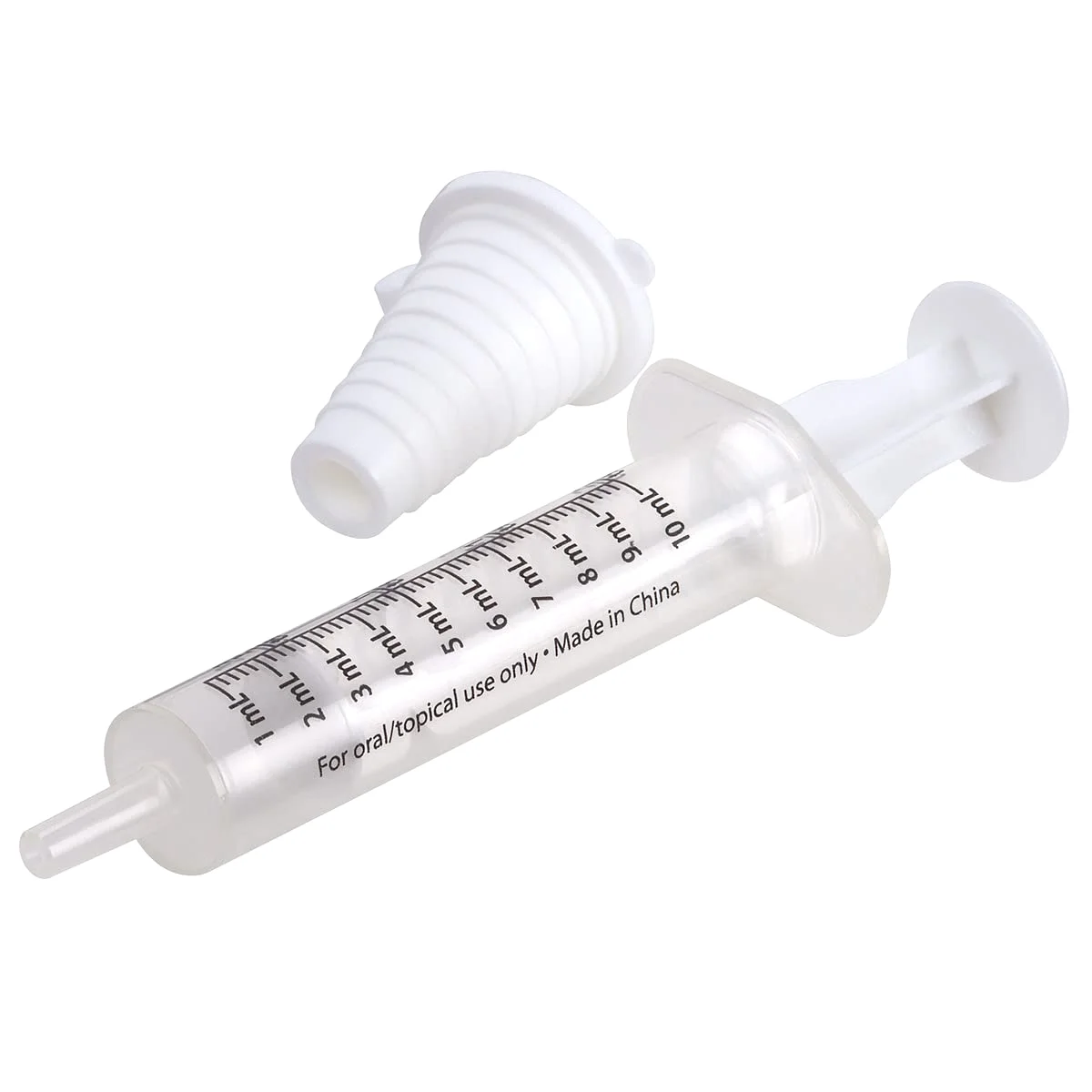
The NIH study calls an oral syringe the most accurate instrument there is for measuring a dose, and the reason is mechanical. The barrel is a straight tube marked in millilitres, the plunger has a flat face, and the dose is the distance the plunger travels. There is no meniscus to read against a curved wall, no tilt to correct for, and nothing to spill on the way to the mouth.
Our syringes come in two sizes for two reasons. The 5 mL barrel is for infant doses, where a half-millilitre matters and the marks are spaced so that 0.5 is a clear step rather than a hairline. The 10 mL barrel is for a toddler's two-teaspoon dose in one draw, so nothing has to be measured twice. Buy the size that matches the doses on the current bottle; a 10 mL syringe drawing 1.25 mL is reading the smallest marks on the barrel, and a 5 mL syringe drawing 10 has to be filled twice.
The bottle adapter is the part that makes it work at night
Pouring medicine into a cup and drawing it into a syringe is a two-handed job with a bottle that wants to tip. The bottle adapter removes the pouring. It is a small ring that presses into the neck of the bottle and stays there; the tip of the syringe pushes into the hole in the middle, the bottle is turned over, and the plunger draws the dose up through the adapter without a drop leaving the bottle. Turn the bottle back, pull the syringe out, and the cap goes on over the adapter until the next dose.
Fit the adapter in daylight, the first time, when the bottle is new. At two in the morning it is already there.
Giving the dose
The tip of the syringe goes into the cheek pouch, between the gum and the cheek, not straight back over the tongue. A dose pushed at the back of the throat makes a child gag, and a gagged dose comes back out. Push the plunger in two or three small steps and let the child swallow between them. For a baby, hold them half upright in the crook of an arm; for a toddler, let them hold the syringe with you, because a hand on the barrel is the difference between a fight and a routine.
Do not add the medicine to a bottle of milk or a cup of juice. If half the drink is left, half the dose is left, and there is no way to know which half.
When the syringe is refused
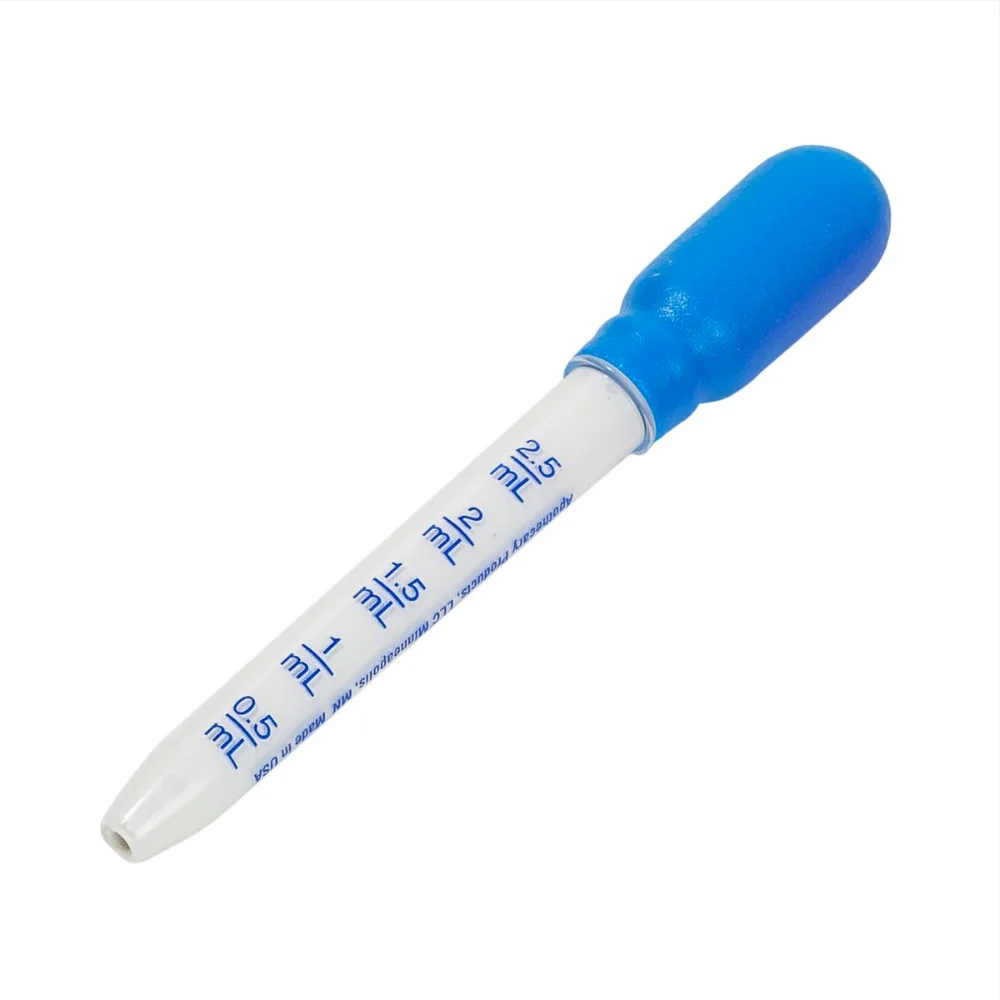
Some children open for a spoon and shut for a syringe, and the range has two answers. The spoon-dropper draws the dose up through its hollow stem to a millilitre mark, like a dropper, and then delivers it from its bowl, like a spoon. The calibrated medicine spoon is a spoon whose handle is a graduated tube: fill the handle to the line and tip. Both keep the millilitre, which is the point, and both work for a child who will accept a spoon from a parent but not a tube.
The plain dropper is for fractions of a millilitre, and for drops into an ear or an eye, and a dropper that has been in an ear should not go in a mouth: keep one to each job. The medicine cups are the adult end of the shelf, ten 1 oz cups marked in millilitres and teaspoons for a cough syrup, read at eye level on a flat surface, because a cup held in the air tilts and reads high.
Washing, storing, and the bottle in the fridge
Pull the plunger out of the barrel and wash both in warm soapy water after each dose, then leave them apart to dry; a plunger put back wet is the one that sticks by Thursday. The five-piece set comes with a brush that reaches the barrel. Store the syringe with the bottle it belongs to, which the AAP recommends for a reason: a syringe that lives with its bottle is the syringe used for that dose, and the marks on it are the marks the pharmacist showed you.
Then put the bottle away. The CDC asks that medicines go up and away and out of sight every time, and it says every time because the moment a bottle is left on the counter for the next dose is the moment a child can reach it. A liquid children's medicine tastes of fruit on purpose, and a child can get into a bottle in under a minute. Poison Help is 800-222-1222, and it belongs in every phone in the house before it is needed.
The short version, for the fridge door
Weigh the child and read the millilitres off the weight row. Read the number aloud, decimal point included. Draw it up with an oral syringe through the bottle adapter. Tip into the cheek, in two or three pushes. Wash the syringe, store it with the bottle, put the bottle up and away. No spoon from the drawer, ever.
More of this sort of thing is in the guides, and the Ezy Dose bench keeps the whole range one click away on the front page.