Before you split or crush a tablet: what the label has to say first
A pill cutter halves what it is given. Whether the tablet may be halved is written in the label and known to the pharmacist, and the list of tablets that must never be split or crushed is longer than most people expect.
This page is general information about medication tools, not medical advice. Whether a tablet may be split or crushed, how much of a medicine to give and what to do about a missed dose are questions for the pharmacist who filled the prescription and the doctor who wrote it.
A pill cutter is a blade in a box. It halves what is put under it, and it has no opinion about whether the thing should be halved. That opinion belongs to two places, the label that came with the prescription and the pharmacist who filled it, and the whole trick is getting it from them before the blade comes down. The cutter and the crusher are the easy part.
The reason for the order is that a tablet is not always a lump of drug. Some tablets are a lump of drug, and a clean break through the score line gives two doses of half the strength, which is why splitting exists at all. Other tablets are machines: a coating that keeps the drug away from the stomach, a matrix that lets it out over twelve hours, a shell that dissolves under the tongue. Cut one of those and the machine stops working, and what the person takes is no longer the dose that was prescribed.
What FDA says, in its own words
The Food and Drug Administration keeps a plain page on tablet splitting, and three sentences from it settle most of the question. Tablet splitting should be done only under the supervision of a healthcare professional. If a tablet is approved to be split, that is printed in the HOW SUPPLIED section of the label and in the patient package insert. Most sustained, controlled or timed-release medicines are not meant for splitting.
The part people miss is the score line. A groove across a tablet looks like permission, and often it is; but FDA is explicit that a score line by itself does not mean splitting has been approved. The score is a manufacturing feature, and the approval is a sentence in the label. Read the sentence, or ask the person who has read it.
FDA adds two pieces of practical advice that a cutter makes easy to ignore. Split one tablet at a time, as each is used, rather than a whole bottle on a Sunday: a split tablet exposed to heat and moisture loses potency, and a bottle of halves is a bottle of slowly weakening doses. And accept that halves are never exactly equal. A tablet that breaks a little off centre gives one dose a little high and one a little low, which matters more for a drug with a narrow margin than for one with a wide one, and that is one more reason the pharmacist decides.
What cannot be crushed, in the pharmacist's words
Crushing is stricter than splitting, because a crusher destroys whatever structure the tablet had. The NHS Specialist Pharmacy Service publishes the working list, and it is worth knowing the categories even though the pharmacist will apply them for you.
Modified-release tablets, which carry MR, SR, XL or LA in the name, release their drug over hours. Crush one and the modified-release properties are lost; all the drug is released at once. That is not a smaller effect, it is a larger one, arriving all at the same time.
Enteric-coated and gastro-resistant tablets, marked EC or GR, carry a coating whose whole purpose is to get the tablet through the stomach intact. The service is blunt: they are not suitable for crushing.
Cytotoxic and teratogenic medicines are not crushed unless there is no alternative, because the powder is a hazard to the person crushing it, not only to the person taking it.
Soft capsules are sealed halves around a liquid or a paste, and are not opened. Some newer formulations, described as amorphous solid dispersions, depend on their structure for the drug to be absorbed at all.
On the other side of the line sit the ordinary ones. Film-coated and sugar-coated tablets usually crush, at the cost of a bitter taste; chewable tablets are made to be broken; most hard capsules open and give up their contents. Which side of the line a particular tablet falls on is a question with an answer, and the answer lives with the pharmacist and the product information, not with the shape of the tablet.
The question, and how to ask it
Take the bottle to the counter and ask two things: whether this tablet splits, and whether it crushes. Ask for each tablet separately, because a schedule of four is four separate answers. A yes to splitting has a follow-up, which is whether the halves go straight into the box or wait until the morning they are used. A yes to crushing has one too: what the powder goes into, because some drugs part company with food and some with dairy.
Write the answers on the list beside the organizer. A yes given in March is still a yes in September, but a new prescription is a new question, and the person filling the box on Sunday should not have to remember.
Once the answer is yes: the cutter
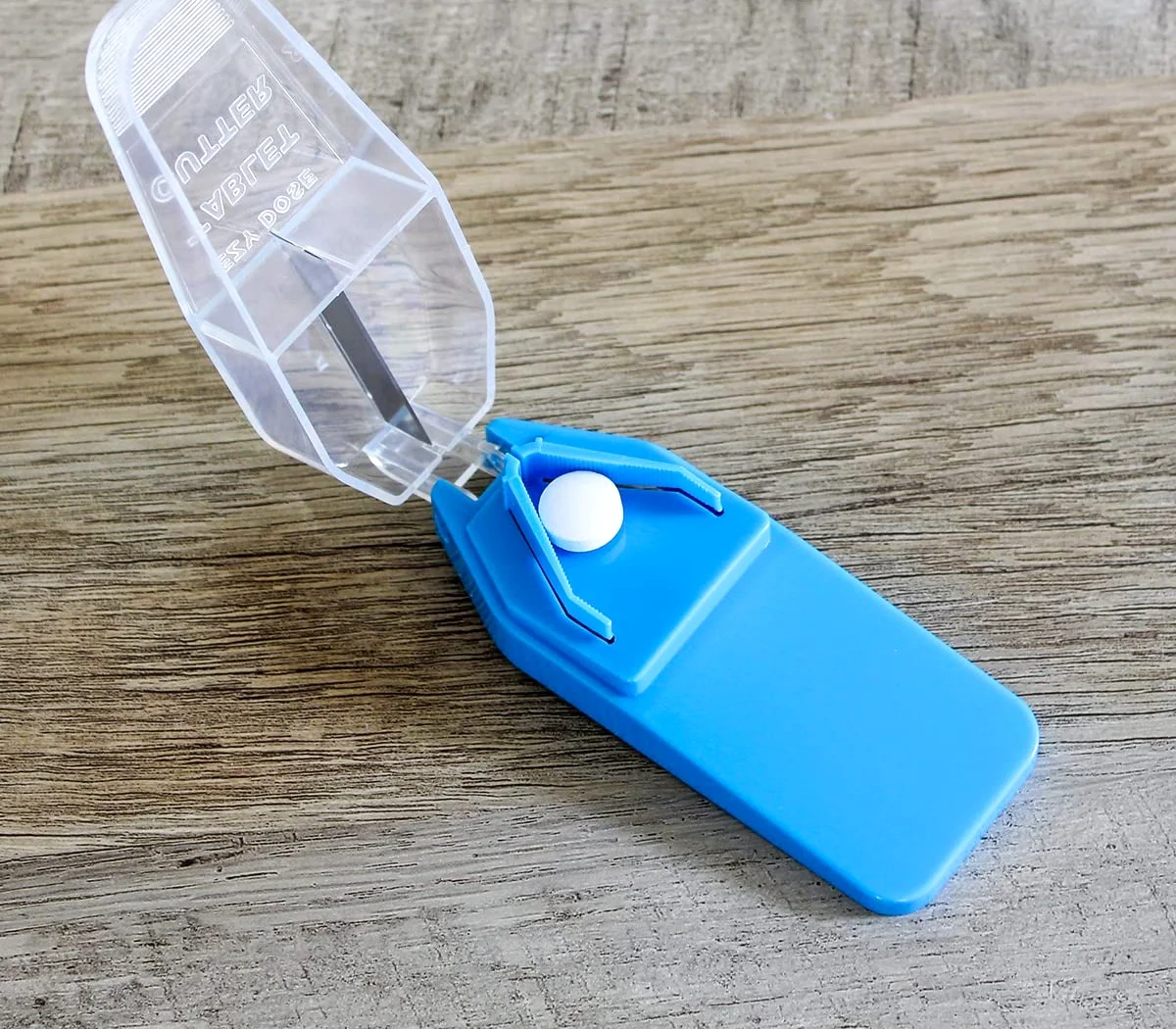
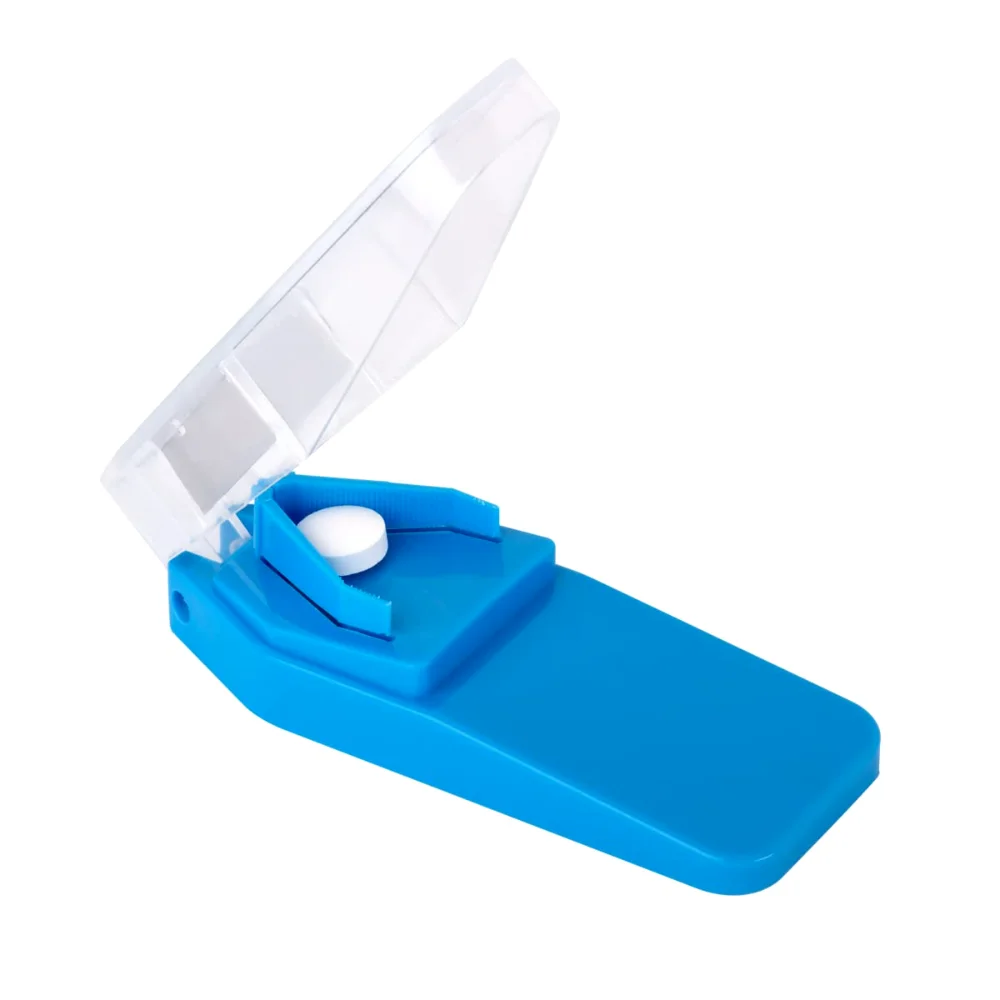
A cutter's job is a straight break on the score line without the tablet skating away, and the difference between our cutters is how the tablet is held while the blade comes down. Every one has a stainless-steel blade and a compartment under it that catches both halves.
The cradle is the part to look at. A V-shaped cradle centres a round or an oval tablet so the score sits under the blade; a flat bed lets a small tablet wander. Put the tablet in with the score line running the way the blade runs, close the lid in one movement rather than a slow squeeze, and the break is clean. A slow squeeze crumbles the edge.
The safety-shield cutter closes a guard over the blade as the lid comes down, so a thumb never meets it. That is the one for a drawer shared with other things, for a child who has learned where the cutter lives, and for a hand that shakes. The dispenser cutters store the halves in a chamber and pour one out at a time, which suits a person cutting a day or two ahead with the pharmacist's blessing. A magnifier in the lid earns its place on a tablet whose score line is a hairline, and the travel size puts the same blade in a body that rides in a coat pocket.
Once the answer is yes: the crusher
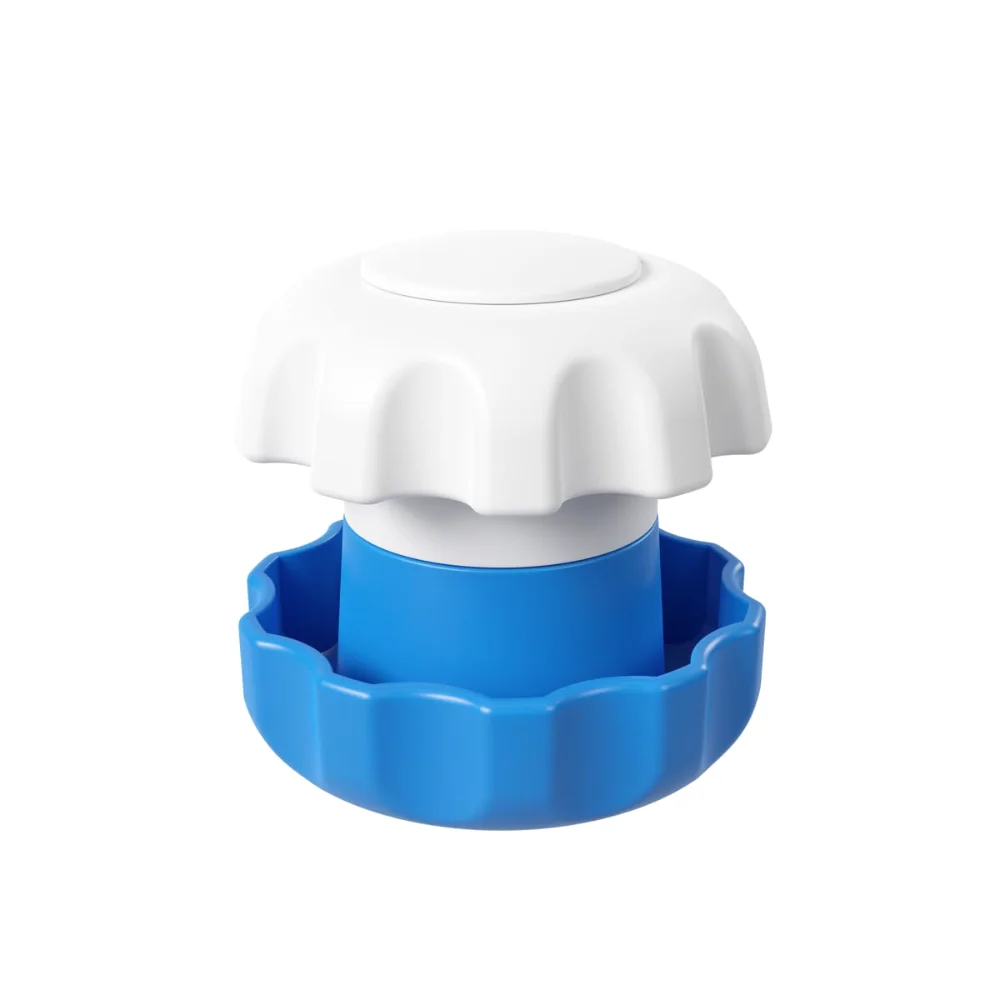
A crusher works by a screw thread. The tablet goes in the cup, the lid turns, and a ridged face grinds it until it is fine enough to stir into something soft. A few turns does an ordinary tablet; a hard one takes more, and the Large crusher with its wider cup gets there sooner.
Mix the powder straight away into a spoonful the person will finish, applesauce, yoghurt, pudding, and do not store it. A crushed tablet has no coating left to protect it and a large surface exposed to air, and it does not keep. Rinse the cup between different medicines so the powder from one does not ride into the next.
The three-compartment crusher stores the next two doses under the grinding cup, so a day's tablets travel with the tool that will crush them. The Cut N Crush and the 3-in-1 crusher-and-cutter put a blade in the lid as well, for a tablet that is split first and crushed second; for a tablet that is only ever split, the dedicated cutters have a deeper cradle and a shield.
For a dog or a cat, the same question with a different answerer
The pet shelf carries a cutter with a safety shield in a dog and a cat version, and the question is identical: may this tablet be split. The answerer is the veterinarian, and the list of tablets that must not be crushed into food is as real for animals as for people. A veterinary school's guidance on giving a pet pills puts it simply: crushing is reserved for the veterinarian or the pharmacist, who can compound the medicine into a form the animal will take. Ask before the first turn of the lid, and give water after the tablet, especially to a cat.
The order, once more
Bottle to the counter. Two questions, splitting and crushing, and a third if either answer is yes: what the pieces or the powder go into. Answers written on the list. Then, and only then, the cutter for a clean break on the score line, one tablet at a time, or the crusher for a powder taken straight away. The tools are on the cutters and crushers shelves. The permission is not, and it never will be.
More of this sort of thing is in the guides, and we at Ezy Dose keeps the whole range one click away on the front page.